The MacBook Neo: This feels like cheating.

Every time I use the MacBook Neo, I feel like I’m getting away with something.
If you have read my previous Overmorrow essays or follow me on Mastodon, you probably know that I am a frequent and unapologetic Windows user, and a Linux dabbler, and a, uh, Chromebook acknowledger. But I am also a longtime admirer of Apple’s hardware and software.
More than that—while my feelings about the company are much more complicated today, in my twenties and early thirties, I was obsessed with Apple. I was also, to use a technical term, broke. This led me to all sorts of interesting places, as I creatively explored the world of the low-end Mac. I tried to make do with whatever archaic Macs I could scrounge up on Craigslist (including using a 12-inch PowerBook G4 more than four years after the Intel transition). I dabbled with making “hackintoshes” during the netbook era. When I did have a new Mac—like when the 11-inch MacBook Air debuted in 2010—I always went with the base model. In that case, a dual-core 1.4 GHz Intel machine with a 64 GB SSD and only 2 GB of RAM.
That MacBook Air was Apple’s most affordable laptop at the time I purchased it, with a starting price of $999. What I remember about it, beyond being elated about its cool design and compact size, was how even this brand-new Apple laptop performed an awful lot like the antiques and hacked-together machines I had been using. In the PowerPC and Intel eras, the base model of the lowest-end Mac was often a trap. It had the most attractive sticker price, the almost-affordable “starting from” number to lure you in, but the real Apple experience came with the upgrades to the higher SKUs (or just with upgrades, back when more components were user-serviceable). I loved that little Air, but I always chafed against its limits. I’m sure for Apple it was more about margin than malice, but using the base model often felt like a punishment.
Which is why using the MacBook Neo is such a revelation. The headline-grabber is a new Mac laptop at a historically low price (for Apple), but I think the real story is just as much about Mac laptop as it is about low price. I’ve had my Neo for all of ten days, so I don’t feel qualified to give it a full “review,” but my thorough first impression boils down to: Whoa. This really is a Mac. It feels good. It feels premium. And it does basically every Mackity thing I’ve tried to do with it, and does it well.
That said, the MacBook Neo is different from other Mac laptops. It would have to be in order to achieve its low price. While I am sure Apple’s crack marketing team would say they built the Neo from the ground up to be affordably premium, it’s hard to look at the MacBook Air and not imagine Apple “decontenting” it to hit the Neo’s price point. Here’s what the Neo lacks, and some of its key limitations:
The Neo is limited to 8 GB of RAM. The Neo’s storage starts at a paltry 256 GB and is half the speed of the MacBook Air’s SSD. The Neo has 6 CPU cores and 5 GPU cores, the fewest of any Apple Silicon Mac. The Neo has shorter battery life than the MacBook Air, no MagSafe, and no fast charging. Its two USB-C ports are slow. The screen is slightly smaller than the Air’s screen, supports fewer colors, and does not support True Tone. There is no backlighting for the keyboard. The trackpad is mechanical and doesn’t support Force Touch. The base model doesn’t have Touch ID.
But the MacBook Neo has a lot going for it, too. First of all, it costs just $599. Its iPhone Pro–class A18 Pro processor is equal to or better than the M1 in almost every measure. And it costs just $599. Its screen has Retina resolution and is just as bright as the current MacBook Air, at 500 nits. And it costs just $599. It has a similar footprint to the Air, the same design language, brighter colors, and the same light weight (2.7 lbs./1.23 kg). And it costs just $599. The Neo runs the full macOS and all Mac software. And finally, no list of the Neo’s features would be complete without at least one passing mention of its price: $5991.
Much hay can be made (and I’m sure the haters have pitchforks at the ready to make it) that several $600 Windows laptops make few (or none) of the compromises listed above. To which I can only say: yes.
But.
Those same laptops make different compromises. I’ve never used a sub-$1000 Windows PC that felt as good physically as the Neo does. I’ve never seen a PC run Windows 11 as smoothly on 8 GB of RAM as an Apple Silicon Mac runs macOS. I spent over four years using an M1 Mac mini with 8 GB of RAM without issue (hey, I’m less broke these days, but not not broke). The Neo so far is no different: macOS works hard not to fill every available byte of memory, and swap is fast and efficient, even with the Neo’s slower SSD. I need to push it more, but so far, I have no problems running more than a dozen apps at once, plus a truly irresponsible number of open browser tabs. It just keeps going.
What I think is hard to parse about the MacBook Neo until you have tried to use one is how well Apple has balanced the tradeoffs. Yes, every one of the limitations listed above could be anything from a papercut to a major bottleneck. In my experience so far, though, none are. The thing that I’ve had the most trouble with—by which I mean the only shortcoming I have noticed more than once—is the lack of a backlit keyboard. I think I can live with that.
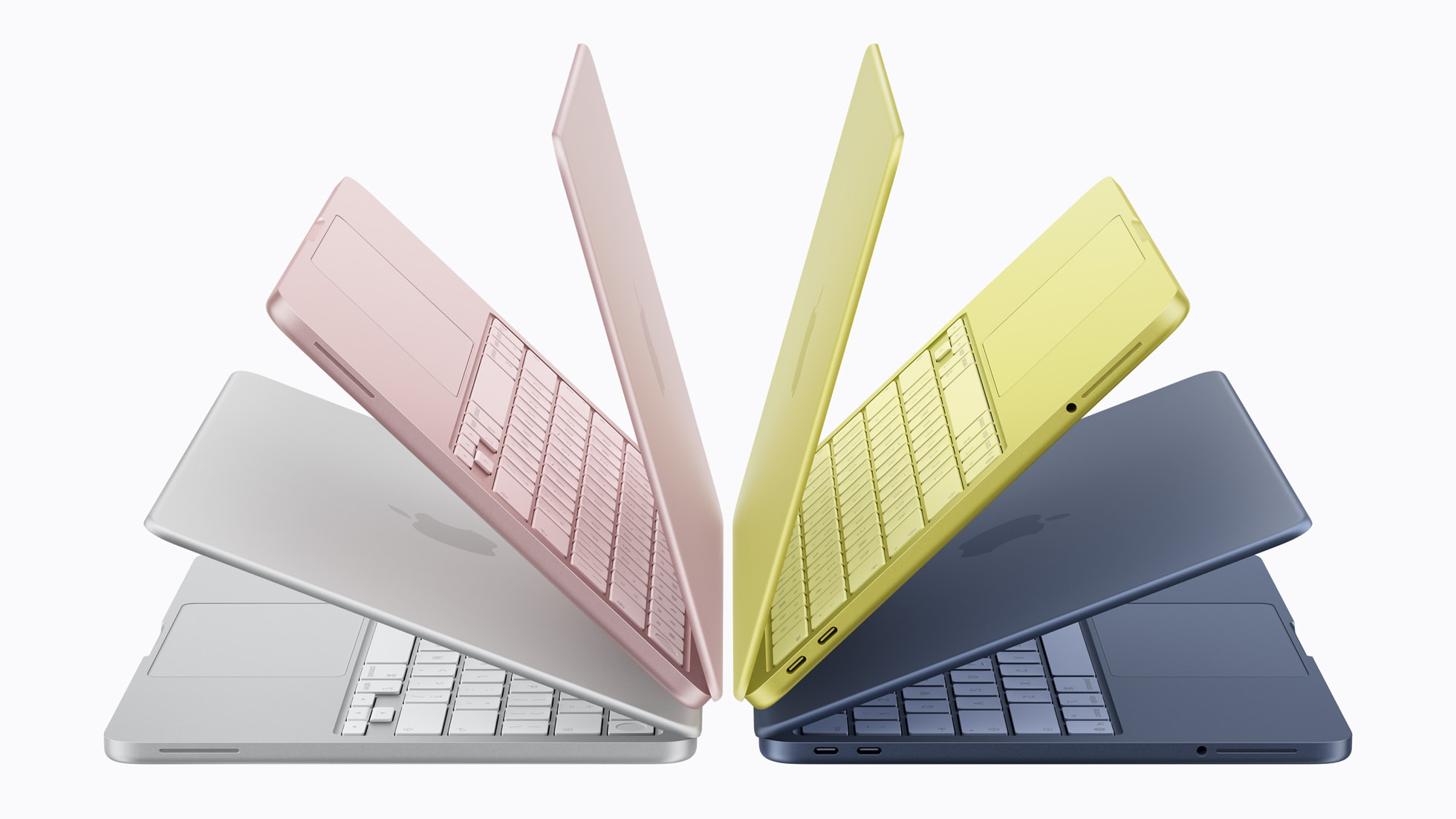
Of course, no discussion of the Neo would be complete without talking about the rainbow elephant in the room. I was initially fooled by Apple’s product photography and my own wishful thinking into believing that Apple had gone all-in on colors for the MacBook the same way they did with the iMac. You could be forgiven for expecting that the Neo’s Blush, Citrus, and Indigo would be straight-up pink, yellow, and blue. In truth, the Blush is definitely pink, but it’s a very silvery pink. Early hands-on reports called Citrus—the color I chose—everything from gold to chartreuse (my wife sees it as straight-up green). I read it as much more yellow than not, but Apple obviously muddied the color more than they did with the yellow iMac. And while the Indigo may be slightly more blue than either the Midnight or Sky Blue MacBooks Air, it wouldn’t be odd to mention them in the same sentence. (Which I just did.) The Neo is the most colorful Apple laptop in a quarter century, but Apple hasn’t completely cut loose. If you squint, Silver, Blush, Citrus, and Indigo could almost be last decade’s Silver, Rose Gold, Gold, and Space Gray.
If the biggest scandal of Apple’s colorful new laptop is that it isn’t colorful enough, I think it’s going to be all right. To be fair to the skeptics, though, part of why it’s so easy to look at what has been left out of the Neo and see flaws is because the Neo is something new. Not that a $600 laptop is new; the entry-level PC is something we’ve had for decades. What we haven’t really had, up until now, is an entry-level Mac laptop. I mean, sure, there was always technically an “entry-level” MacBook. Something was at the bottom of the price list. And, as alluded to above, the Intel-era MacBook Airs were extremely entry-level in specs and capabilities. But they weren’t entry-level in materials, in industrial design, in look-and-feel. And they certainly weren’t entry-level in price.
The MacBook Neo changes that, though. Apple Silicon, Apple’s manufacturing chops, and some very well-thought-out tradeoffs have allowed Apple to release a very compelling laptop (even more so in day-to-day use than it is on paper), and for a historically low price. The story of the Neo isn’t what Apple left out. The story of the Neo is about what is and is not necessary for a laptop to be good. This early into owning one, I’m not yet comfortable making a blanket recommendation about it; I am very confident in saying, though, that Apple is going to sell millions of these, many to first-time Mac buyers. And, deficits notwithstanding, those buyers are going to be happy with their purchase.
They will feel, like I do, as though they are getting away with something—like they paid a discount PC price but are somehow using a fully-capable, premium Mac.
And they will feel that way because they are.
1: We could argue that the “real” starting price is $499, which is the education price; Apple is heavily marketing that price and most of the Neo’s target audience will qualify. On the other hand, I think the case can also be made that the “real” price is $699, the price with Touch ID and 512 GB of storage, because those are must-haves. So, for the purpose of this essay, I’m splitting the difference and just referring to it as $599 (which, incidentally, is exactly what I paid by using the educational discount for the upgraded SKU).