Make it weird.
The Lenovo Yoga Book 9i is unhinged. It's a computer with the form factor of a laptop, but with a second screen where the keyboard, palm rest, and trackpad would normally go. When used in a laptop configuration, a Bluetooth keyboard can magnetically attach to the lower touchscreen while leaving room for a virtual trackpad or other controls. However, the Yoga Book 9i can also be used in several other, completely bananas configurations (for a detailed breakdown, see Paul Thurrott’s review from earlier this year). Its dual-screen design, hinge, and accessories make it both ridiculously adaptable and plainly ridiculous.
What caught my attention about this machine, though, wasn’t so much that Lenovo was crazy enough to make it, but that Microsoft nearly did, too.
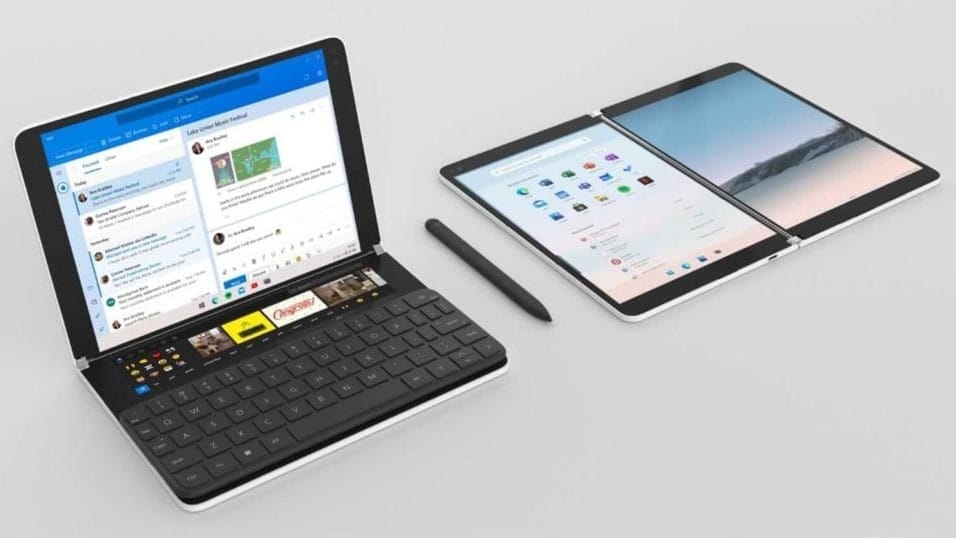
Microsoft announced the never-released Surface Neo six years ago, along with its also-never-released operating system, Windows 10X. A smaller version of what Lenovo would later build in the 9i, Neo instantly captured my imagination, because it encapsulates what I always found compelling about Microsoft’s in-house line of PCs:
They’re fucking weird.
The iconic Surface design—an iPad-ish tablet with an integrated kickstand and a magnetic, detachable keyboard cover that flops down in front of it—is now over a decade old and has been copied for other PCs, Chromebooks, Android tablets, and the iPad itself (though, often, with the kickstand as part of an add-on case). But it was a strange, interesting choice when it debuted, because it wasn’t especially, for lack of a better term, lap-able. It was a portable computer that could be used as a tablet, or as a desktop. It might have been a “laptop replacement”; it was definitely not a laptop.
The endurance—and imitations of—the Surface form factor blunts some of the initial surprise about its design. But that design highlights the original goals of Surface: to push the limits of the PC form factor, and to spur innovation from Microsoft’s OEM partners. And while Surface itself may no longer seem weird or innovative, think about everything that came with it, and that followed in its wake.
The first two generations of Surface shipped alongside the Touch Cover, whose keyboard was largely conceptual—nearly flat and completely immobile, it detected keypresses by capacitive touch and pressure sensors (and shipped in a nostalgic CGA color palette of black, white, cyan, and magenta).
There was also the mostly-forgotten Surface Music Kit, a Touch Cover, but with sliders and sixteen chunky square buttons meant to mimic a DJ or producer’s mixing board.
The breakaway-keyboard madness continued with the Surface Book, a more traditional laptop-like form factor, but one whose accordion hinge flexed and curved instead of folding sharply like most laptops, meaning it never quite closed flat. Oh, and while the screen was a detachable tablet, two-thirds of the battery stayed behind in the keyboard. Along with, sometimes, the GPU.
Then there’s the Surface Studio, an iMac-like all-in-one whose screen can be used in a vertical orientation (you know, like a screen) but can also be lowered into a “drafting table” orientation to allow artists to go nuts with their Surface Pens. The Surface Studio eventually begat the Surface Laptop Studio (same idea, but now it’s a laptop?).
Oh, and the Surface Dial. A Bluetooth-connected shuttle wheel peripheral that, with most Windows PCs, can be used to scroll or control volume. With the Studio or some Surface Pros, though, the Surface Dial could be stuck directly onto the screen, producing a dynamic radial menu to act on whatever content you had just covered up with the two-inch dial.
Surface has also seen a lot of playfulness in materials. Surfi have shipped not only in aluminum cases but also in magnesium, and often fabric. Touch Covers, Type Covers, and many Surface Laptops’ keyboard decks have been clad in Alcantara of various colors and finishes. Who wants carpet on their laptop? It’s a good question, but the answer is clearly somebody, because Microsoft is still shipping Alcantara.
The Neo would have represented the apotheosis of weird Surface shit, had it ever shipped. But it didn’t, due to the failure of an overly ambitious rethink of Windows and a not-quite-satisfactory chip from Intel. And after the Neo, Microsoft’s appetite for the weird has abated. The Studio line and the more wackadoodle accessories are gone. So are most of the zany colors of the early days—the bright reds became burgundy, then disappeared. Cyan turned to bright blue, which was replaced by a more professional “cobalt blue” (not very cobalt, but still blue), which then gave way to “ice blue” (literally just gray), and now “ocean.” Is ocean green? Is it blue? No. It’s ocean. (At least they also shipped a purple Surface this year.)
Arguably, the Surface line has been pared down to what works: the iconic convertible tablet, the laptops, and just enough keyboards, mice, and docks to make them useful.
But I also can’t help but feel that something has been lost. The exploration, the inventiveness, the transgressiveness of Surface always appealed to me. Surface was Microsoft trying to take on Apple in industrial design and innovation. And while the key word there is trying, I still think a lot of what they produced was worthwhile, interesting, and useful. I’m writing this on a Surface, in fact. (If you’re curious, it’s the “ocean” Surface Pro 12, because I like green, and I like blue, and I like the ocean. Not that it looks like any of those, but I was hopeful.)
If you believe that the 34-year-old laptop design that debuted on the PowerBook 100 is the PC’s final form, that’s fine—the laptop as we know it isn’t going anywhere any time soon. But me? I’m a tech enthusiast because I like possibilities. I like designs that take chances. The laptop in its current form is better than the portable computers that came before it; this implies that there might also be something better that comes after the laptop.
It’s not my biggest disappointment about Microsoft. Hell, it’s not even my biggest disappointment about Microsoft this week. But I am disappointed that Microsoft seems to have given up on being weird, and on trying to figure out what comes next.